
Generational Change From Carriage to Electric
The first developments of transportation began with horses and buggies and eventually advanced to steam powered engine vehicles. Most people consider Electric Vehicles to be a recent development, but to the surprise of many, EVs have been around as early as the 1800’s. The progression of EVs will forever transform the landscape of transportation. Let’s time travel back into EV history to see how vehicles evolved from the initial ways of transit to what the future has in store.
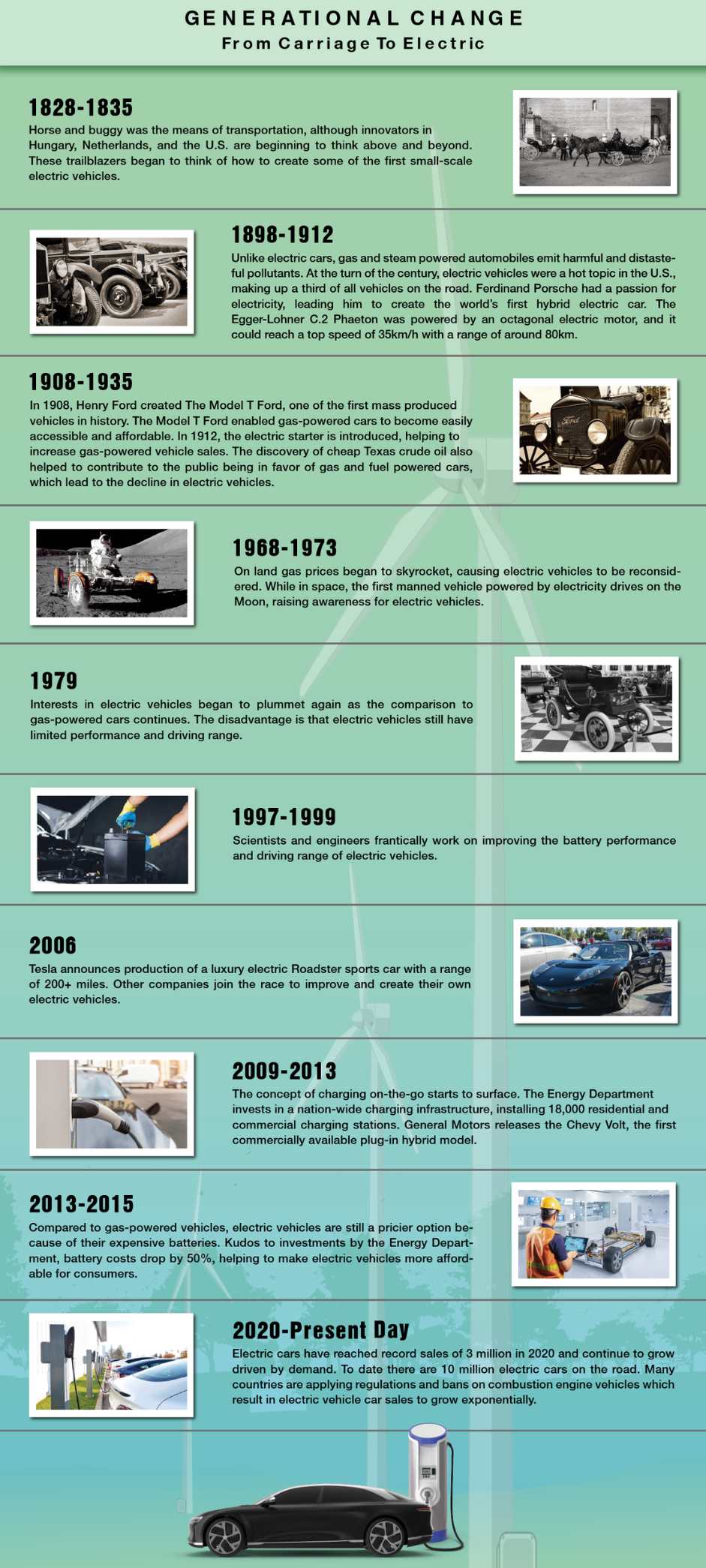
1828-1835 - Horse and buggy was the means of transportation, although innovators in Hungary, Netherlands, and the U.S. are beginning to think above and beyond. These trailblazers began to think of how to create some of the first small-scale electric vehicles.
1898-1912 - Unlike electric cars, gas and steam powered automobiles emit harmful and distasteful pollutants. At the turn of the century, electric vehicles were a hot topic in the U.S., making up a third of all vehicles on the road. Ferdinand Porsche had a passion for electricity, leading him to create the world’s first hybrid electric car. The Egger-Lohner C.2 Phaeton was powered by an octagonal electric motor, and it could reach a top speed of 35km/h and a range of around 80km.
1908-1935 - In 1908 Henry Ford created The Model T Ford, one of the first mass production vehicles in history. The Model T Ford enabled gas-powered cars to become easily accessible and affordable. In 1912, the electric starter is introduced, helping to increase gas-powered vehicle sales. The discovery of cheap Texas crude oil also helped to contribute to the public being in favor of gas and fuel powered cars, leading to the decline in electric vehicles.
1968-1973 - On land gas prices began to skyrocket, causing electric vehicles to be reconsidered. While in space, the first manned vehicles powered by electricity drives on the moon, raising awareness for electric vehicles.
1973-1977 - The 70’s was known as the era of bell bottoms and disco, and the consciousness of being environmentally friendly began gaining traction. Environmental threats were caused by the disposal of toxic waste, resulting in movements promoting cleaner air and water. Big players and small automakers begin their journey of exploring alternative fuel vehicles. The Citi Car, a wedge-shaped compact car with a battery range of 50-60 miles made its debut.
1979 - Interests in electric vehicles began to plummet again as the comparison to gas-powered cars continues. The disadvantage being that electric vehicles still have limited performance and driving range.
1997-1999 - Scientists and engineers frantically work on improving the battery performance and driving range of electric vehicles.
2006 - Tesla announces production of a luxury electric Roadster sports car with a range of 200+ miles. Other companies join the race to improve and create their own electric vehicles.
2009-2013 - The concept of charging on-the-go starts to surface. The Energy department invests in a nation-wide charging infrastructure, installing 18,000 residential, commercial, and charging stations. A lot is converging during that time. General Motors releases the Chevy Volt, the first commercially available plug-in hybrid model.
2013-2015 - Compared to gas-powered vehicles, electric vehicles are still a pricier option because of their expensive batteries. Kudos to investments by the Energy Department, battery costs drop by 50%, helping to make electric vehicles more affordable for consumers.
2020 -Present Day- Electric cars have reached record sales of 3 million in 2020 and continue to grow driven by demand. To date there are 10 million electric cars on the road. Many countries are releasing regulations and bans on combustion engine vehicles which resulting in electric vehicle car sales to grow exponentially.
Why are we making the switch to EVs?
Combustion or fuel-powered engines are triggering a series of carbon emissions that pollute the atmosphere and increase the greenhouse effect, during the following:
In the electronics industry, attaching a through-hole component to a mixed board is no longer a difficult and costly process. Placement of a solder paste near or over a through-hole is one method that manufacturers have tried but this can be challenging due to spillage or inconsistency of volume.
With Solder Preforms, this is no longer the case.
Solder Preforms find their homes in many different but essential applications:
- Oil extraction at the well
- Transporting crude oil to a refinery
- Refining oil to gasoline process
- Delivering fuel to gas stations
- Combusting fuel in the vehicle’s engine
The reduction of vehicles with Internal Combustion Engines on the road will lead to cleaner air and a healthier environment for us all.
Potential Drawbacks
The electric vehicle market brings many innovations but also challenges. Many people still think that electric vehicles are more expensive than gas powered cars. Although, the initial cost for an electric vehicle is higher, energy prices are at an all-time high, causing the costs to charge EVs to go up as well. This increases the demand for more public charging stations.
Despite the efforts by the Department of Energy to increase the amount of readily accessible EV charging stations, there is still an insufficient number of charging stations in the nation. The lack of charging stations on the roads cause consumers to have range anxiety because they never know when their next charge will be, and it can take an extensive amount of time to charge EVs. These concerns could potentially limit EV growth.
What is the future after electric vehicles? What’s next on the horizon?
eVTOLs
Short for electric vertical take-off and landing aircraft, these vehicles of the sky are sometimes referred to as ‘air taxis’ or ‘flying taxis. Powered by batteries, eVTOLs operate and navigate like helicopters and are designed to carry two to six passengers along for the ride.
These aircrafts can take off and land vertically and are already being used in Singapore and China. These electric flying taxis deliver packages and take important people from one place to another. As time goes on, they will be used as conveniently and casually as we use our everyday car.
What did we miss? What other history is important in the evolution of EVs?
How COINING comes into play
Today’s connected, automated, and fast-paced EVs rely on the high-quality materials that are needed to provide the necessary interconnects that enable safety and reliability. COINING supplies a wide range of metal micro components that are optimized for the challenges of electric vehicle applications. From the wiring of EV battery systems to interconnects in power modules, our solder preforms, bonding wire, copper clips, and bond pads are used throughout electric vehicles.
COINING, a world-class AMETEK brand, is the largest solder preform manufacturer in the world. We have our own in-house lab staffed with the most experienced metallurgists around to make custom alloys, so even the most advanced ideas can materialize.